

Net Zero Is Moving From Sustainability Reporting to Capital Allocation
A guide for CFOs, Strategy Heads, and Investment Committees navigating India’s energy transition
Here is a number that should be in every Indian CFO’s strategic briefing: USD 500 billion per year.
That is the annual investment India needs to fund its Net Zero transition through 2070, according to NITI Aayog’s 2026 study. Current annual flows stand at approximately USD 135 billion. The gap of USD 365 billion every year represents the single largest capital mobilisation challenge in India’s economic history.
Now here is the number that matters for your organisation: USD 22.7 trillion.
That is the cumulative investment requirement under India’s Net Zero Scenario. Over half of it flows through the power sector. Significant portions move through industry, transport, and buildings. This capital is going to be deployed. The question is who deploys it, who captures the returns, and who bears the cost of not being positioned.

Why This Is a Financial Strategy Conversation
The standard framing of sustainability investment is cost management: how do we reduce energy bills, avoid carbon penalties, and comply with emerging regulation? That framing is not wrong, it is just incomplete.
The more consequential framing is this: in a capital environment where USD 22.7 trillion of investment is being directed toward low-carbon assets, which organisations are positioned to attract that capital, deploy it productively, and generate returns from the transition?
Several dynamics are already reshaping capital allocation in India:
Green financing is becoming cheaper: ESG-linked debt instruments, green bonds, and sustainability-linked loans now carry lower spreads for credible issuers. Organisations with verified sustainability targets and transparent reporting have a measurable cost-of-capital advantage over those without.
Import exposure is a balance sheet risk: India currently imports 89% of its oil and 47% of its gas. Fossil fuel price volatility is therefore directly embedded in the cost structures of any energy-intensive business. The NITI Aayog modelling projects fuel import bills dropping from 4% of GDP in 2022 to 0.9% by 2050 in the Net Zero Scenario, a structural improvement in the national current account. For energy-intensive businesses, the equivalent transition offers comparable balance sheet relief.
Valuation multiples are beginning to bifurcate: Global institutional capital, which is increasingly the marginal buyer in India’s equity and debt markets, applies sustainability screens. Companies with credible transition roadmaps are experiencing multiple expansion; companies without credible roadmaps face increasing scrutiny.
The USD 6.53 trillion financing gap between what India can mobilise domestically and what the Net Zero Scenario requires is a market signal rather than just a policy problem.
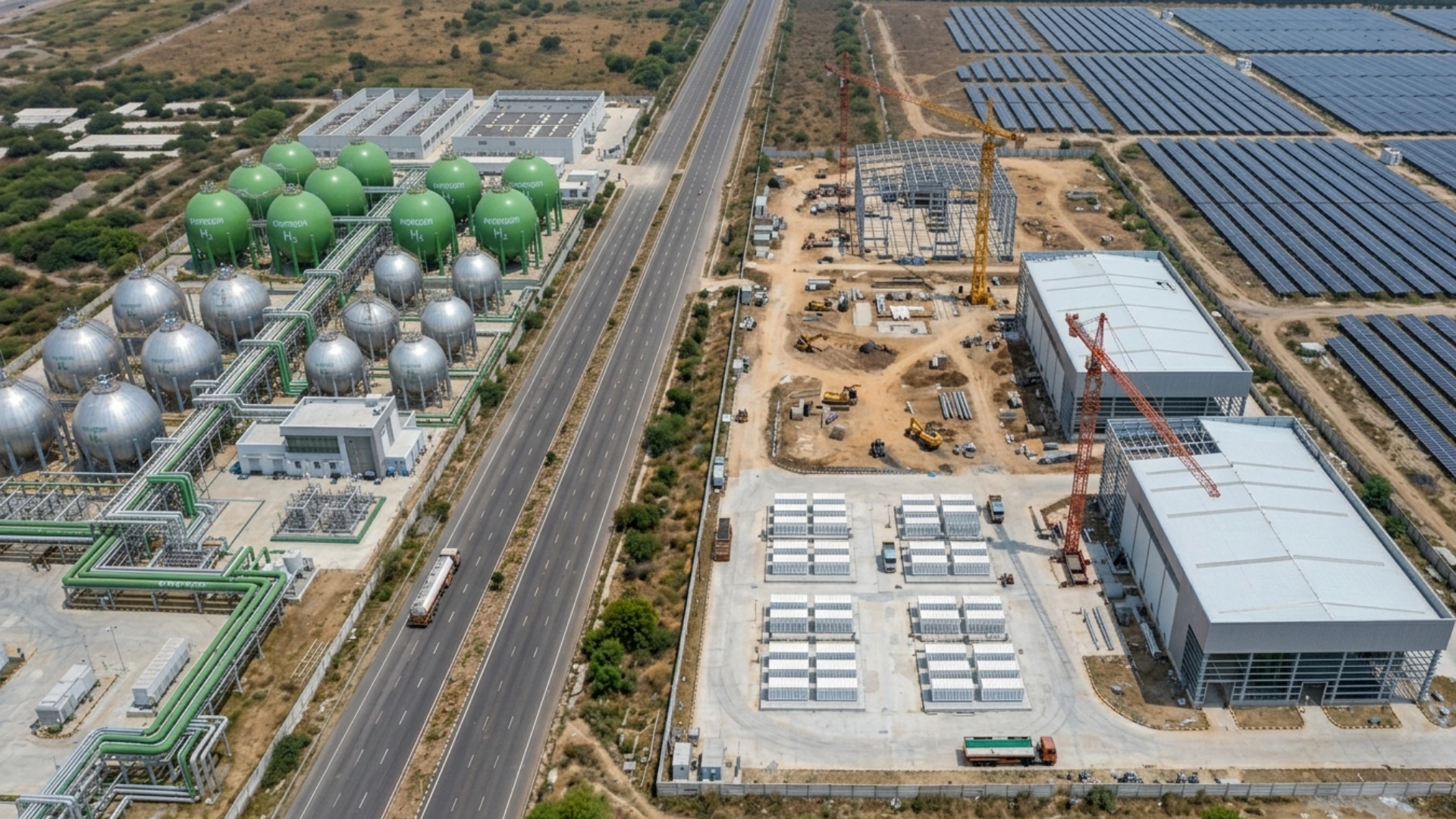
Where capital is scarce and demand is certain, returns are available. The renewable energy sector, battery storage, green hydrogen, energy-efficient buildings, and clean industrial processes all sit in this category. Indian companies with the balance sheet, execution capability, and strategic intent to participate in these sectors are entering a decade-long growth window with limited competition from established incumbents.
For conglomerates and diversified companies evaluating their portfolio composition, this is a portfolio allocation question of the highest order. Which business units are exposed to transition risk? Which are positioned to capture transition opportunities? Is the board actively managing this distinction?
What a Credible Financial Strategy for the Transition Looks Like
Based on the NITI Aayog framework and the investment landscape it describes, a credible financial strategy has four components:
Transition risk audit: A rigorous assessment of which assets, cost structures, and revenue streams are exposed to carbon pricing, regulatory tightening, and market preference shifts. This is not a sustainability exercise; it is a stress test.
Capital reallocation roadmap: An explicit plan for shifting investment from high-carbon to low-carbon assets over defined time horizons, integrated with the existing capex cycle. Not aspirational, but planned, funded, and tracked.
Green financing strategy: An active engagement with the green bond market, sustainability-linked loan structures, and ESG-oriented institutional investors. India’s corporate bond market is deepening; the organisations that build green financing capability now will access better terms at scale later.
Sustainability-linked KPIs in performance management: Targets that connect executive incentives to transition milestones like energy intensity reduction, renewable procurement, and Scope 1 & 2 emissions. So that sustainability strategy becomes operational reality.
The Macroeconomic Context Is Supportive
The NITI Aayog modelling offers one particularly significant reassurance: India’s GDP trajectory toward USD 30 trillion by 2047 is resilient even under the Net Zero Scenario. The transition does not compromise growth, it reshapes its composition, shifting from consumption-led to investment-driven, with industry’s share of GDP rising to 33% by mid-century as the clean energy and manufacturing scale.
For CFOs, this means the transition is a structural component of how India’s growth gets financed and delivered over the next two decades.
The question is not whether your organisation participates in this transition. The question is whether it does so strategically or reactively.
The difference between those two paths will be measured in returns.
Related posts